What causes the appearance of a droopy upper eyelid?
-

Jean-Paul Abboud, MD, PhD
- Mar 21, 2020
- 3 min read
Updated: Apr 9, 2020
No two people are the same, and no two eyelids are the same either. It is with this in mind that I approach a patient with a complaint of “droopy upper eyelids.”
Droopy upper eyelids can give the eyes a tired, sleepy, and aged appearance. In my practice, I frequently see patients in consultation who seek an “eyelid lift” to rejuvenate the area around their eyes. However, the eyelids do not exist in isolation, and as such, lifting them solely may not be the definitive solution.
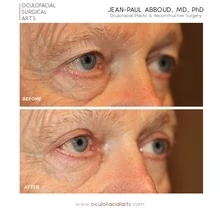
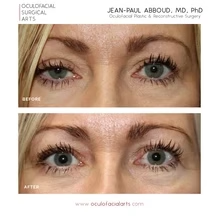

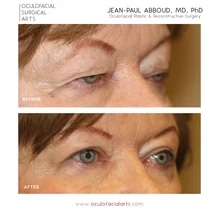
To appreciate this concept, it is important to have a thorough understanding of eyelid and facial anatomy as well as the effect of aging on the eyelids and the facial structures. The eyelid is an inherently loose structure that is tightly attached on either side to the bony orbit (eye socket) via ligaments, similar to a hammock. The eyelid gets its structural support from the amalgamation of connective tissues, muscles, fat, and skin. Any disruption of these tissues may cause malposition of the eyelid.
As aforementioned, the eyelids are not a solitary system. Instead, they form a continuum with surrounding facial structures and are thus influenced by them. For instance, the upper eyelids are intimately connected to the brows and forehead. The lower eyelids, on the other hand, are intimately connected to the cheeks and midface. As such, any age-related effect on the brows can contribute to upper eyelid droop, and any age-related effect on the cheeks and midface can contribute to lower eyelid droop.
As we age, the face undergoes three main changes: 1) changes in skin texture and quality, 2) changes in volume, and 3) changes related to gravity over time. With time, the skin becomes loose, wrinkled, and redundant. Fat is lost in certain areas and herniates in others. The connective tissues that support our facial structures and the muscles that lift them are soon overcome by the effect of gravity, and consequently, these facial structures start to descend.
The area around the eyes are not immune to these age-related changes. As such, when examining a patient with droopy upper eyelids, I look at three main things: the height of the eyelid margin (or lashes) in relation to the pupil, the quality and quantity of the upper eyelid skin (and fat), and the position of the brows. Essentially, the appearance of a droopy upper eyelid is due to:
-
excess upper eyelid skin (known as dermatochalasis), often with herniation of eyelid fat (known as steatoblepharon)
-
descent of the upper eyelid (known as eyelid ptosis)
-
descent of the brow (known as brow ptosis)
-
multifactorial causes as a result of a combination of the above